
The Reserve Bank of India (RBI) on Tuesday announced a fresh round of liquidity measures through open-market operations (OMOs) and a foreign exchange buy-sell swap, under which it will inject close to Rs 3 trillion into the banking system. The central bank said it would purchase Government of India securities worth Rs 2 trillion through OMOs, spread across four tranches of Rs 50,000 crore each to be conducted on December 29, January 5, January 12 and January 22.
Reserve Bank on Friday decided to cut Cash Reserve Ratio (CRR) by a huge 1 per cent, which will unlock Rs 2.5 lakh crore liquidity to the banking system for lending to productive sectors of the economy. With the reduction in four equal tranches ending November 29, 2025, the CRR would come down to 3 per cent.

Opening up the corner office is fine, but will the government be able to attract talent without giving a market-rate salary?, asks Tamal Bandyopadhyay.

Activity in the corporate bond market is set to gain momentum following a 25-bp policy repo rate cut by the rate-setting panel of the Reserve Bank of India (RBI). State-owned public cebPower Finance Corporation (PFC) and Small Industries Development Bank of India (Sidbi) are planning to raise up to Rs 11,500 crore through bonds on Tuesday as issuers expect borrowing costs to ease.

'Economic activity appears to have peaked in the second quarter of FY26, with industrial output, exports, and business confidence all softening from October 2025.'

Mint Road's proposals on banks' M&A funding are cautious even as entrants root for more elbow room, and weigh business models.

By enabling real-time data sharing, the platform will help prevent scams and ensure secure transactions.
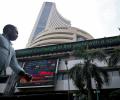
Like with all great crashes, some had noticed the cracks. "... cash balances (of banks) seem, from the available indications, to be hopelessly inadequate; and it is hard to doubt that in the next bad times they will go down like ninepins. If such a catastrophe occurs, the damage inflicted on India will be far greater than the direct loss falling on the depositors," said John Maynard Keynes in his May 1913 work "Indian Currency and Finance", written before his path-breaking work in macroeconomics laid the foundation of dealing with global crises.

By all available indications, the White House drafted a face-saving note and handed it, ready-made, to Islamabad. Pakistani Prime Minister Shehbaz Sharif was supposed to then post it in the guise of a plea urging Trump to extend the deadline by two weeks 'to allow diplomacy to run its course'. Trump would then graciously accept Pakistan's 'request' and declare a ceasefire. Sharif dutifully posted the message on X. Except that he, or whoever was handling the account, forgot to delete the tell-tale first line visible in the edit history: 'Draft - Pakistan's PM Message on X'. Prem Panicker's must read blog on the Iran War.

As India's biggest Unified Payments Interface (UPI) app PhonePe prepares to list, the updated draft red herring prospectus (DRHP) shows the impact of regulations on the business, and concentration of payments-linked revenue even as UPI lacks MDR (merchant discount rate).

From the Sensex firms, State Bank of India, Bajaj Finserv, Bajaj Finance, Maruti, HCL Tech, Larsen & Toubro, Mahindra & Mahindra and Infosys were among the major winners. However, Hindustan Unilever, Eternal, Tata Motors Passenger Vehicles, and Sun Pharma were among the laggards.

Equity markets fell on Monday, with benchmark indices recording their worst session in over two months amid caution ahead of the US Federal Reserve's (Fed's) policy announcement and renewed uncertainty over the US-India trade deal. Sustained selling by foreign portfolio investors (FPIs) also weighed on sentiment.

Ahead of the Reserve Bank of India's (RBI's) monetary policy review in the first week of December, major public sector non-banking financial companies (NBFCs) - the National Bank for Agriculture and Rural Development (Nabard), Small Industries Development Bank of India (Sidbi), Power Finance Corporation (PFC), and Indian Railway Finance Corporation (IRFC) - plan to raise up to Rs 24,000 crore together through bond issuancesk.

Among Sensex firms, Bajaj Finserv, Bajaj Finance, Tata Steel, Reliance Industries, Sun Pharma, Tata Motors Passenger Vehicles, Axis Bank and Infosys were among the major gainers. Bharti Airtel and Asian Paints emerged as the laggards from the pack.

The Indian economy is likely to grow at 7.4 per cent in 2025-26, up from 6.5 per cent in the previous fiscal, mainly on account of better performance of manufacturing and services sectors, as per the government data released on Wednesday.

'There is no shortage of fuel whatsoever.' 'India is stock surplus as far as petrol and diesel are concerned.'

India has managed high government debt-to-GDP, a slowing domestic revenue engine, lower household savings and a more hostile geopolitical environment separately in the past. But together, they threaten to undo the growth narrative on which today's optimism rests, warns Debashis Basu.

Despite corporate bond yields hardening by 20-25 basis points, Indian corporates are not warming up to bank funding for their capital expenditure needs as bank lending rates remain elevated due to the higher cost of liabilities, compared to current rates in the debt capital market.

Banks have been borrowing heavily from the Tri-Party Repo (TREPS) market and deploying those funds into the Standing Deposit Facility (SDF) of the Reserve Bank of India (RBI), which is offering higher interest rate than the former, leading to increased volumes in the SDF window. The weighted average TREPS rate was trading at 5.66 per cent on Monday, 9 basis points lower than the SDF rate which currently stands at 5.75 per cent.

The government bond yield curve is likely to flatten in the financial year 2027 (FY27) as the Reserve Bank of India (RBI) is expected to ease supply pressure in the ultra-long segment. In FY26 so far, reduced investments by insurance companies and pension funds pushed up yields on ultra-long tenor securities, steepening the curve.

Despite a higher CAD in the first quarter, capital inflows were broadly adequate to finance the current account gap, requiring only a marginal drawdown of foreign exchange reserves.
The Reserve Bank on Friday announced a record Rs 2.69 lakh crore dividend to be paid to the government for the fiscal ended March this year, 27.4 per cent more than the payout in 2023-24. The Reserve Bank had transferred Rs 2.1 lakh crore dividend to the government for the fiscal 2023-24.

Notwithstanding global headwinds, the Indian economy saw further momentum in October on the back of goods and services tax (GST) rate rationalisation and festival spending, as indicated by high-frequency indicators, the Reserve Bank of India's (RBI's) monthly State of the Economy report said.

The RBI has flagged concerns over rising volatility in gold prices and advised lenders to exercise caution in the gold loan segment.

State debt is rising because revenues are disappointingly weak. Ten states have debt ratios exceeding 30 per cent. In 2023-2024, states were borrowing simply to meet day-to-day expenses, points out Debashis Basu.
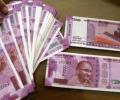
The high-value Rs 2000 notes worth Rs 6,099 crore are still in circulation even after two years of the Reserve Bank withdrawing the currency, according to official data released on Tuesday. Rs 2000 banknotes continue to be legal tender.

Retail inflation slipped to 1.54 per cent in September from 2.07 per cent in the preceding month mainly due to subdued prices of food items, including vegetables and pulses, according to government data released on Monday. The consumer price index (CPI) based inflation was 5.49 per cent in September 2024.

Sensitive issues remain. Water sharing of the Ganga and Teesta rivers. Treatment of minorities, particularly Hindus. Border management. Trade imbalances. Connectivity projects.What happens next will shape not just bilateral ties, but the balance of South Asia itself, points out Ramesh Menon.

'Rate cut looks unlikely and there is reason to believe that the cycle is over.'
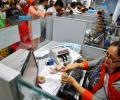
Each employee is generating more business than before -- driven by cost rationalisation, digital adoption, and better resource utilisation -- signalling a stronger foundation for sustainable growth and profitability.

New investors should enter gradually and with a long horizon. 'Staggered investment through systematic purchase plans is advisable rather than lump-sum buying.'

It is unlikely that the RBI will drop rates until the inflation rate drops below five per cent.

The Indian rupee, swaying through multiple headwinds, tiding over global trade disruptions and massive foreign fund outlfows, is unlikely to arrest its descent until tariff impact overhangs, notwithstanding robust domestic macroeconomic tailwinds. The Reserve Bank of India (RBI), which sees the rupee's depreciation as a silver bullet to offset the tariff shock, expects the currency to find its stable course once India reaches a trade deal with its largest trading partner, the US.

The Reserve Bank of India (RBI) on Friday delivered a 25 basis point (bps) repo rate cut analysts expected, driven by the strong 8.2 per cent GDP growth in the September quarter. However, analysts do not expect a runaway market rally as the impact of US tariffs continues.

The rupee slumped 5 per cent in 2025 as persistent capital outflows from foreign investors, alongside heightened dollar demand from importers, making it one of the worst-performing Asian currencies.

Rural India outpaced urban centres in passenger vehicle sales in 2025, recording a growth of 12 per cent compared with 8 per cent in cities.

India's first maritime lender, state-owned Sagarmala Finance Corporation Ltd (SMFCL) hit the ground running with a Rs 4,300 crore disbursement announcement last Tuesday, within months of being registered as a non-banking financial company (NBFC) in June 2025.

In response to the panic triggered by Trump's trade policies, the RBI net sold approximately $43 billion in the second half of FY25 to curb volatility, as the rupee plunged to a low of 87.95 per dollar in February this year.

From the Sensex firms, Tata Motors jumped the most by 5.54 per cent, followed by Kotak Mahindra Bank, Trent, Sun Pharma, Axis Bank, and ICICI Bank. However, Bajaj Finance, State Bank of India, UltraTech Cement and Tata Steel were among the laggards.

This was the near-unanimous replies of 10 market participants.
